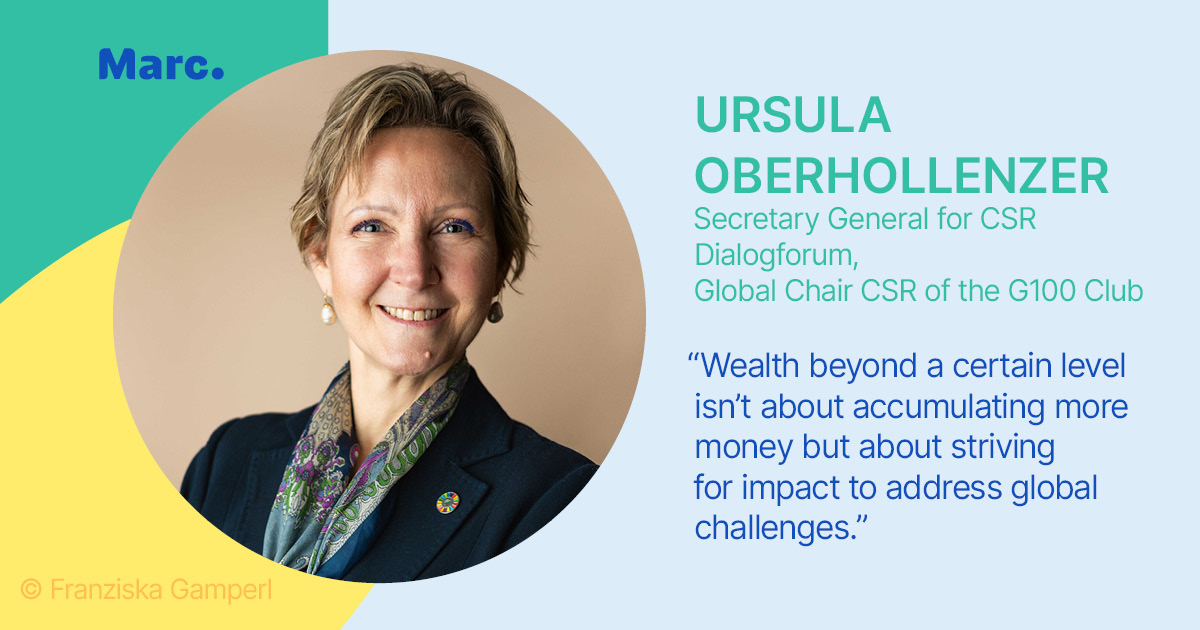
Ursula Oberhollenzer is the Secretary General for CSR Dialogforum, which is a competence centre for integrated business and society focusing on projects, ideas, companies that are active in the territory of social responsibility. The Dialogforum members accept the triple bottom line concept: their responsibility on economical, ecological and social impact of what they are doing. Ursula is an impact investor herself, and she also collaborated with the University of Economics in Vienna to develop an impact measurement methodology based on SDG indicators. Furthermore, she is Global Chair CSR of the G100 Club, an international network of women in leading roles, aiming at implementing SDG 5 by 2030. We asked her for an interview on the Vienna Impact Days in June, 2024.
How do you see field of impact investment in Austria?
Impact investment in Austria is not yet where it should be in the financial ecosystem, it needs a much bigger presence. The definition as well as the legal framework of this type of investment is not very clear, challenging. This is why we (the Impact Investing Network Austria / IINA) are developing this segment of the financial system in Austria.
It’s interesting to hear this perspective, as from the viewpoint of the CEE countries, we see Austria as a stronghold of impact investment. How did Austria reach this point, and what steps can CEE countries follow?
I began my engagement in impact investment in 2015, collaborating with Charlie Kleissner, a global leader in the field. Initially, impact investment projects were difficult to execute as investors often had different priorities, leading to stalled projects. In my view, impact investment wasn’t on the radar until 2020 and remains a niche, although it’s growing. In Austria, Impact Hub, ERSTE Foundation, and many smaller foundations and organisations are drivers, and the ecosystem is developing quickly. The German impact investment market is even beyond Austria, with the Impact Investing Network (INA) the Austrian Chapter of the German BIII (Bundesinitiative Impact Investing) fueling our growth. Erste Bank, through the ERSTE Foundation, plays a unique role. Unlike other banks constrained by legislative limitations, the ERSTE Foundation enjoys greater flexibility.
Aside from the influence of organisations and individual investors, what other significant drivers are shaping the impact investment landscape?
New generations entering the workforce and founding startups seek more than just financial returns. Although Covid set us back, we’re witnessing a resurgence in impact startup formation. The challenge is funding, especially at the seed stage, which NGOs legally cannot support. Legal changes are needed to allow NGOs to invest in profit-generating ventures to help early-stage ideas mature.
Additionally, we should make impact investment accessible to individuals, including small investors. I personally invested in a crowdfunding platform where investments start as low as 100 EUR. There’s risk in every investment, but many people, like me, want their money to make an impact. Wealth beyond a certain level isn’t about accumulating more money but about striving for impact to address global challenges. Redirecting money towards necessary changes could transform the economy, potentially leading to a future where impact investments and enterprises outnumber traditional ones.
How would the world be different if the impact economy and impact investment became dominant (or mainstream) instead of remaining niche?
We would live in a more just, equal, and sustainable world. This transformation is essential because our current exploitation of the planet is unsustainable. It’s our responsibility to choose the right path. There is no business on a dead planet; we must shift money to safeguard our living and address outrageous inequalities too. Women, in particular, feel this urgency and must ensure their voices are heard.
What determines success or failure of impact enterprises? What are their biggest challenges?
The initial challenge for impact enterprises is transforming an idea into a startup and securing initial funding. Many startup ideas fail at this stage. Once past this, maintaining team enthusiasm and alignment becomes crucial. Initial enthusiasm may decrease, but the founding team needs to stay aligned, collaborative and determined. Marketability is another significant challenge; some ideas sound promising but have limited market potential. It’s essential to develop startups with a clear impact plan and thorough market research, but this requires funding too.
Unexpected obstacles, such as legal or executional constraints, can cause a startup to miss critical targets, leading to failure. After this, as the enterprise grows, finding funding partners who value impact over pure financial returns is vital. These partners should offer not only financial support but also their expertise and commitment to the enterprise’s impact goals.
Additionally, overconfidence among successful startup founders can lead to failure. Ignoring external opinions and inputs, even from their investors, can be detrimental. Success or failure often hinges on many small factors, including those not immediately apparent.
Is it more difficult to establish an impact startup compared to a for-profit one?
For profit businesses are easier to finance due to existing legislation, but their investors come with higher pressure to get returns on their investment, and this can be burdensome. Founders can be stressed and forced to work faster that they would like, leading to a potential failure.
In the Marc Impact Programme, we help impact enterprises and startups to grow and become finance ready. What would be your message or recommendation to them?
Keep dreaming but keep your feet on the ground. Find the right network, contacts, ecosystem, where you can realise your dreams. Establish the setting around yourself, where you can grow. Find people with the right know-how to support your idea, find those who can help with funding, and find ways to grow, to scale up, to move forward.
The Marc Impact Programme helps with the above, application is open until end August.