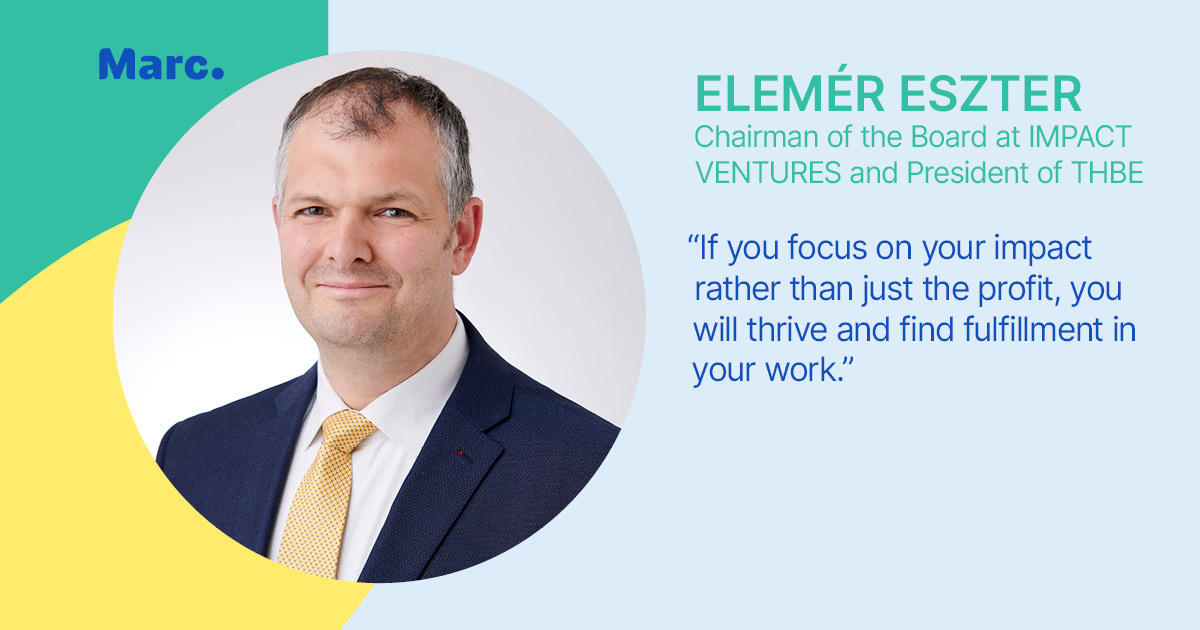
Elemér Eszter stands as a prominent figure in Hungary’s impact investing landscape. As the Chairman of the Board at IMPACT VENTURES, one of the first regional impact venture capital fund management company focused on socially and ecologically responsible investments, and President of THBE, the Social Impact Investors Association, he is at the forefront of this evolving sector. We spoke with him about the current state and future trends of impact investing, both globally and specifically within Hungary.
What sparked your interest in impact investing, and how did you become involved?
My journey into impact investing began in 2015 at the CEE Impact Days in Vienna Impact Hub. As a venture capitalist I was already well-versed in Hungary’s venture capital and private equity markets. At the event, I encountered pioneers such as Charly Kleissner, a global leader in impact investing, and Johannes Weber, founder of Ananda Ventures, a prominent German impact fund. Their stories deeply resonated with me, particularly the case of BioLite—a camping stove designed for mountain trekkers that was adapted to benefit African families. The stove not only revolutionised cooking methods but also served as a generator to charge mobile phones, improving connectivity and potentially transforming lives.
The dual success of BioLite, in terms of both social impact and profitability, ignited my passion for this field. I realised that profitable enterprises could indeed address social and environmental challenges. My current definition of impact investing is about solving social and ecological problems in a measurable and profitable way.
Do you believe impact investing has gained traction in recent years, and if so, why?
Impact investing can be narrowly defined as a corporate fund investing in a scalable enterprise that sustainably and profitably addresses a social or ecological problem with measurable impact. Note, that this involves meeting five challenging criteria: impact, profitability, scalability, sustainability, and measurability. Globally, impact investing has certainly gained popularity in recent years. It began trending in the US during the 1990s and in Europe around 2000, although its roots extend back much further. For instance, Tibor Héjj established the Napraforgó Foundation over 25 years ago in Hungary, consistently fulfilling these five criteria while in line with its nonprofit legal form reinvesting its gains into growth, and significantly improving the lives of individuals with disabilities.
How would you characterize the impact investment ecosystem around you? What roles do THBE and IMPACT VENTURES play in it?
Our association, THBE, comprises approximately 40 members, including impact investment funds, banks, major consulting firms, angel investors, and private individuals. After delving into impact investing, I quickly established connections with prominent German funds like Ananda and BonVenture, as well as the European Investment Fund (EIF), Europe’s largest fund of funds, which has invested in around 1200 venture capital funds, including about 60 dedicated to impact investing. IMPACT VENTURES PLC is Hungary’s first officially registered impact venture capital fund. We are currently in the registering phase for our third capital fund and are proud that our investors continue to place their trust in us. Our focus encompasses Europe, with particular attention to Central and Eastern Europe and the Western Balkans, while we also engage with many local players in Hungary’s ecosystem.
What is your perspective on the impact investment market in Hungary as part of the broader venture capital landscape?
Impact investing shouldn’t be viewed as a standalone sector; rather, it exists on a spectrum that ranges from funding NGOs and social enterprises to supporting start-ups with measurable social or ecological impact. Hungary’s venture capital ecosystem includes investors, investees, capacity builders, consultants, and policymakers.
Perceptions of this market in Hungary vary significantly. Some refer to venture capital in negative terms such as “vulture capital” or “fishing in troubled waters.” However, it’s important to recognise that venture capital is a key engine of economic growth, especially in high-potential enterprises that come with considerable risk. For example, IMPACT VENTURES evaluated 4,200 applicants and selected 20 promising businesses for investment, fully aware of the inherent risks involved in early-stage investments.
How do you assess the maturity and trends of Hungary’s impact investing market?
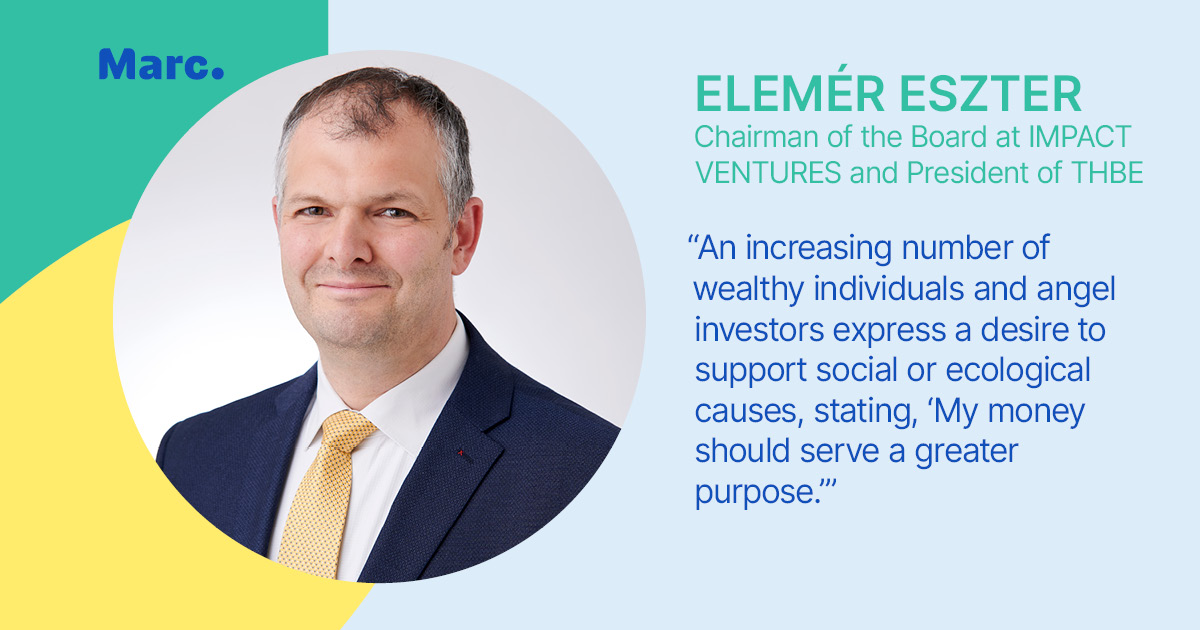
In my view, the Hungarian impact investing market is still in its early and somewhat immature stages, akin to a teenager on the cusp of adulthood. There remains a scarcity of finance-ready enterprises and investors inclined toward impact investing. Nevertheless, an increasing number of wealthy individuals and angel investors express a desire to support social or ecological causes, more often than ever stating, „my money should serve a greater purpose.” However, in Hungary’s short-term capitalist environment, many successful businesspeople tend to rely solely on their own abilities, showing skepticism towards effective management and collaboration. Family offices or trusted family fund trustees are relatively rare.
On a positive note, numerous pioneering initiatives, accelerators, and incubators have emerged over the past 10 to 15 years in Hungary, such as NESsT, Impact Hub Budapest, the Badur Foundation and SIMPACT. These initiatives are gaining traction and attracting further stakeholders. Additionally, there is a growing interest among university graduates in purposeful careers that promote social or ecological values, which helps to advance this ecosystem. Moreover, policymakers are beginning to recognize the importance of this sector and are laying the groundwork for its growth. For example, the Gábor Baross Programme has introduced a dedicated section for supporting environmental impact investments, and new funds have been established in the realm of green and renewable energy. The Hungarian National Bank is also making significant efforts to align with Western Europe in terms of green financing. In summary, while the market has yet to fully mature, numerous robust drivers are paving the way for its future development.