Interview with Univ. Prof. Dr. Michael Meyer
Institut für Nonprofit Management
Wirtschaftsuniversität (WU) Wien
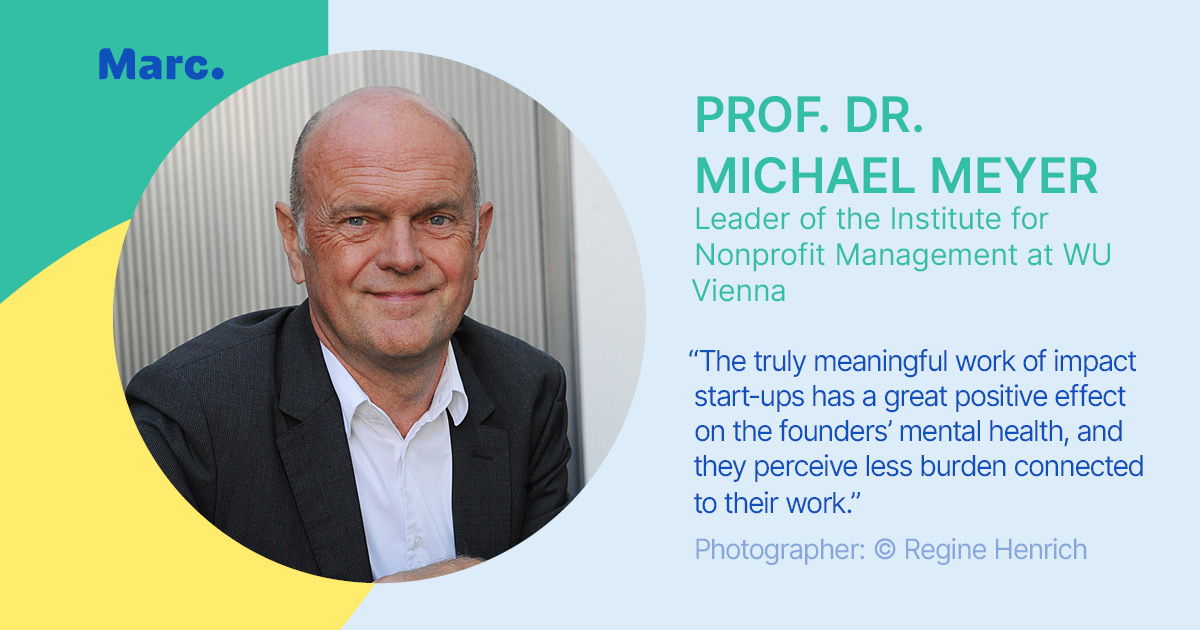
University Professor Dr. Michael Meyer leads the Institute for Nonprofit Management at WU Vienna and is co-founder of the NGO Academy programme, which has been running for over 10 years. We spoke with him about the impact economy, social and environmental investment, and entrepreneurial education at the Impact Days in Vienna.
Firstly, what are your routes and connections to the impact economy ecosystem?
In 2013, we founded the NGO Academy programme with ERSTE Foundation. This programme aimed to strengthen the capacity of classic NGOs, it involved knowledge transfer but even more importantly networking and building social capital among NGOs in the CEE region. NGOs in the region are facing overly difficult circumstances with huge challenges of human rights, democracy, social services etc. We recently started to widen our horizon beyond NGOs towards social businesses and impact start-ups, as they also strive to fulfil social goals, but in a financially sustainable way. Beyond contributing to social and ecological well-being of our countries, impact enterprises add to economy development sustainably. Many players of the business sector are also concerned with social and ecological challenges that we see nowadays, and impact initiatives are highly valued and desperately needed.
How do you see the impact economy as part of the total economy?
The impact economy is often considered niche, but I would challenge that notion. When we take a closer look at many for-profit businesses, we often find guiding principles or mission statements that prioritise social or ecological value over purely financial gains. Even large companies like Google have an impact-driven goal, such as democratising knowledge. Many small enterprises also emerge with the intention of contributing to their local community, whether it be improving access to education, promoting healthy lifestyles, or other social benefits. While these enterprises must generate profit to survive, their initial motivation is often impact-focused. The impact economy may seem niche if defined too narrowly, but it is growing rapidly, and I believe it will gain further significance in the coming years.
What are the key success or failure drivers of impact enterprises in your view?
The success drivers are so numerous and complex that those who master all of them may become rich and famous. They range from competencies, dedication, realistic market assessment, business planning, financial background and support, proper partnerships, especially financial partnerships are critical, and special financing tools need to be available and leveraged to enable financial viability and growth. The purpose of the enterprise should touch a social or environmental pain point with significant marketability. But there are many more success drivers, and there is a possibility also to compensate the lack of some of them via strength in others. For example, a general agreement is around the necessity of the founding “hero” to have extreme dedication and endurance. But this can be compensated by a less dedicated, but well-aligned founding team, as engagement can also be distributed. Typically, a local supporting ecosystem is a success driver too, but it may be compensated by international support etc.
Is it more difficult to run an impact start-up vs. a normal start-up?
I can answer this based on research I conducted with my colleague Peter Vandor. This research surveyed about 900 start-up entrepreneurs across the globe through the ImpactHub network. Our hypothesis was that it is indeed more difficult for founders to run an impact start-up, to fulfil diverse demands from social to financial. Therefore, impact founders may quickly get to burnout. The data proved that the truly meaningful work of impact start-ups has a great positive effect on the founders’ mental health, and they perceive less burden connected to their work, which may even lower the likelihood of burn out. But sadly, on the other side, the conflicting social and financial interests become an immensely heavy burden when external profit-oriented investors get involved. These investors may expect significant financial returns, which we should imagine almost like interest rates, or dividends, which the start-up must find ways to return to the investor. This pressure can be released via impact investor involvement, who is relaxed about profit expectations, and focuses more on the generated social or ecological impact.
How could a bank, or specifically Erste support or help develop these enterprises or this ecosystem more, to increase the chances of success?
The role of banks is to provide financing while pushing the boundaries of what is possible in social banking. Each country has its own regulations around banking, debt, and equity, but we cannot expect founders, or their families, to bear all the financial risk. Finding innovative ways of financing is essential, and large banks like Erste must take a leadership role in this. For example, they could develop social impact funds that offer equity investments to promising start-ups. In our region, the „equity culture” is still relatively weak, and there are few direct business investors. I can imagine a model where banks run programmes that pre-select ventures, assess their risk, and present them to other potential investors, including individuals who might invest with a clear understanding of the risks involved.
What do you think about enterprise capacity building programmes, and specifically about the new Marc Impact Programme?
I have not seen many capacity building programmes for impact enterprises. There are some programmes supporting start-up entrepreneurs, those are typically incubation programmes, which aim to develop a specific business idea into execution, with a single-minded focus on making the idea fly. I see the Marc Impact Programme as very different, it is not for seed ideas, it is for relatively grown entrepreneurs, who want to become finance-ready, and it is truly building the capacities of the venture team. And I expect that this programme will provide a very balanced mix of hands-on experience and theoretical knowledge. The theory can be conveyed to the participants via lecture-type activities, and the hands-on experience comes via executing tasks themselves for developing their own enterprise with guidance. Case studies of real failures and successes are demonstrated, and coaches and mentors help the participants with many years of experience in the field, either as one-on-one coaches, or as panel discussion members, answering their real-life challenges. When the participants enter the programme, they bring their challenge or obstacle, which hinders them from finance-readiness, and during the programme they do their best to solve this challenge via the knowledge and experience they gain. So, I expect that the programme will support not only the project or venture but also the person, the entrepreneur. During the 10+ years of NGO Academy, I learned that if we develop the person, the specific project may still fail, but the knowledge of the person remains, and his next project may succeed.
In Central Europe, our perception is that Austria is well ahead in the development of social economy and impact enterprises. Is that true, and in case yes, how could CEE catch up?
I’m not sure that Austria is as far ahead as some might think. From my experience, there are many deeply engaged people in the CEE region who are ready to fight uphill battles. In Austria, I would describe actors more like fat and happy. Many of the country’s social service providers operate in an oligopoly, collaborating closely with the government. Austria is a highly developed welfare state, but it isn’t particularly innovative or inspiring. There’s a widespread belief here that the government should solve all problems, allowing people to relax. Going towards the East, I see much less of this attitude.
Although this may be true, we still seem to find less of the somewhat developed, close to finance-ready impact enterprises in CEE. What could be the reason of this?
This mainly comes down to the financial ecosystem and the distribution of wealth. In Austria, many individuals and companies have reached a level of wealth where they can and want to invest in socially responsible causes. There are fewer such investors in the CEE region. It’s not that there aren’t wealthy individuals or companies in CEE, but the conviction to invest in socially impactful ventures is less widespread. If there was a larger supply of funding in CEE, more impact entrepreneurs would take chances to grow. Even in the field of banking, more banks and larger divisions offer social banking in Austria than in CEE. Erste Group itself may have a greater role to play in CEE than in Austria, financing more impact enterprises. Furthermore, those investment structures are largely missing in CEE, which would fill in the gap to finance those enterprises, which are below the banking criteria. These are mostly private investors, many of whom are smaller.
How do you see the social and impact enterprise related education in our region? Do we get chances to learn at universities, how to succeed in impact economy?
Even Austria is far from developed in this respect. Our university, WU Vienna, which is one of the very big business schools globally, has an Institute for Nonprofit Management, but it only offers two courses on social entrepreneurship. In business universities, even general non-impact entrepreneurial education is weak, and in CEE, I see it as a disaster. I think that most, if not all CEE countries missed their chance to fundamentally reform their higher education after the fall of the iron curtain. Based on the collaborations we had so far, we see that old professors remained in charge, while young, talented, enthusiastic co-workers or students left their countries. In fact, many of our talented students at WU Vienna are from CEE, and we appreciate this, while being concerned about their local education opportunities. Probably not enough CEE students return to their home after studying abroad and leverage their knowledge to the advantage of their country. Impact and sustainability related management studies are strongest in the UK I would say, and we see great schools in Scandinavia, and some in France, Spain and Italy. But arguably, impact enterprise management mostly needs to be learned outside universities, in practice and in programmes like Marc, or connected to institutions like ImpactHub.