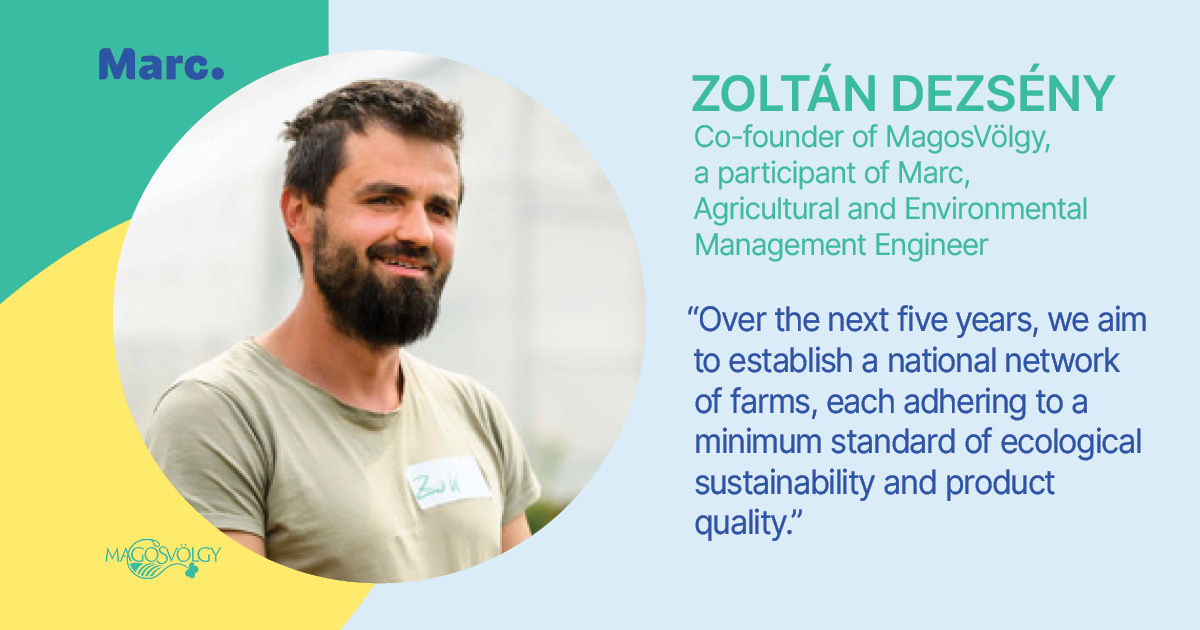
An interview with Zoltán Dezsény, co-founder of MagosVölgy Ecological Farm and Ltd., Agricultural and Environmental Management Engineer.
Zoltán Dezsény is a participant in Hungary’s Marc Impact Programme, which is helping him, and his team develop a network of ecological farms operating under the Community Supported Agriculture (CSA) model. This initiative aims to provide families with a sustainable and healthy food supply.
Your ecological farm is far more than just a farm. Can you describe your mission behind it?
MagosVölgy Ecological Farm was established 11 years ago with a focus on providing 170-200 families with fresh, seasonal produce through a Community Supported Agriculture (CSA) model. We employ an innovative, eco-friendly cropping system based on permanent bed compost mulch cover and minimum tillage farming. This approach has allowed us to run a stable, successful farm, providing year-round seasonal vegetables from our market garden and meat, eggs, and other goods channelled from other trustful small-scale producers. Families pay an annual membership fee in exchange for this sustainable food supply.
Two years ago, we expanded by founding an Ltd., which aims to share our expertise with other farmers and to-be-farmers interested in adopting similar ecological practices. Through hands-on support and knowledge transfer, we help them establish resilient, sustainable agricultural systems like ours, avoiding the common pitfalls we’ve learned to overcome.
How does the knowledge transfer process work?
We have set up an educational hub in the former pub of our village in Terény, which has been renovated for this purpose. Here, we conduct group workshops, in person and online one-on-one coaching, and immersive, on-farm practical experiences. Additionally, we offer tailored support through either on-site visits or remote consultations, helping farmers to plan and establish their own ecological farms.
Are you seeing demand for your consultancy and knowledge transfer services?
Yes, demand is steadily growing, although we are still in the early stages. We issued our first invoice just over a year ago, and currently, the farm’s income is about six times greater than our consultancy services. We’re investing significant time and effort into refining our business model and service offerings.
What led you to apply to the Marc Impact Programme?
Marc provides the tools and guidance necessary to develop and scale our vision. Our goal is to develop a clear business model, action plan and financial strategy, all while remaining aligned with our core values.
My wife and I co-founded the original farm, and recently, we welcomed Anna and Levente—former CSA members—into the Ltd. as new co-founders. Anna has extensive experience in client service and tender writing, while Levente brings a background in IT and multinational business. Together, we aim to leverage each co-owners’ unique skills to create a sustainable, values-driven enterprise.
Rather than expanding by purchasing more land, we are focused on helping others establish their own small-scale ecological farms. By offering both short- and long-term support, we hope to grow a collaborative network of farms, enabling product sharing, quality control, and mutual support.
What are your goals for the outcome of this programme?
Our primary goal is to complete a comprehensive development and business plan for the Ltd., including a resource plan outlining both human and financial requirements. At present, we rely solely on the four co-founders for capacity, but we foresee the need for additional resources—whether in the form of employees, partners, or financial investment—as we grow. We hope Marc will help us clearly identify these needs and equip us with a clear roadmap for growth.
What level of growth are you aiming for?
Over the next five years, we aim to establish a national network of farms, each adhering to a minimum standard of ecological sustainability and product quality. This would enable families across Hungary to source their food from local, healthy and ecologically responsible farms. Additionally, we envision a collaborative network of farmers, united by shared values, who can work together to strengthen the movement toward sustainable agriculture.