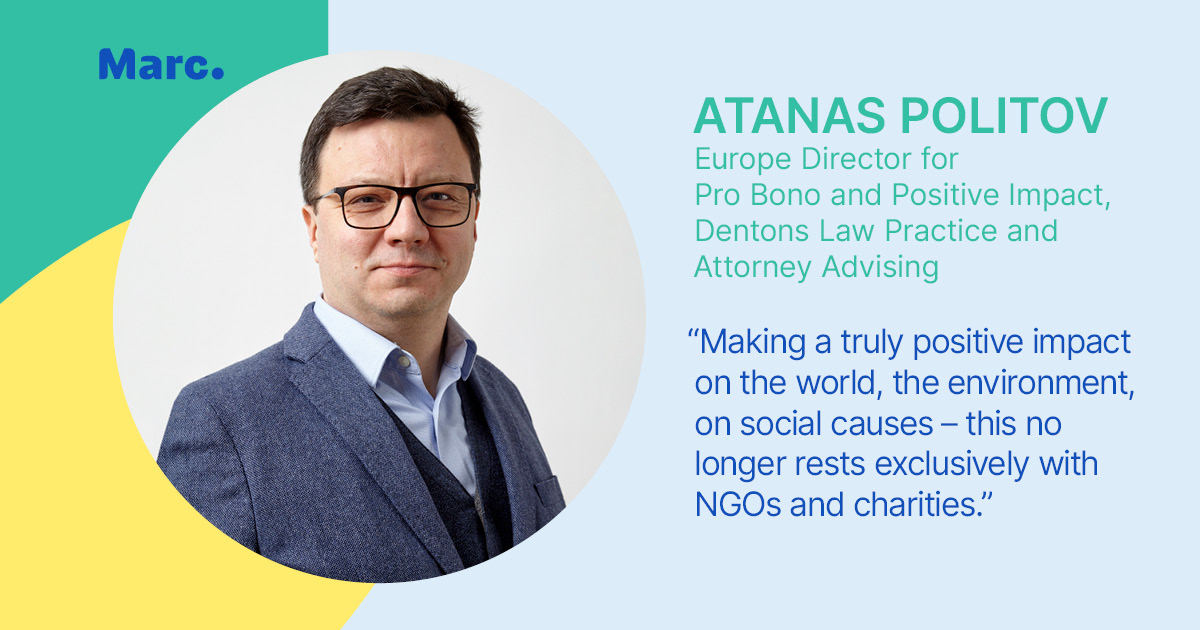
Atanas Politov, Europe Director for Pro Bono and Positive Impact, Dentons Law Practice and Attorney Advising
Global law firm Dentons is a member of the Marc Impact Programme ecosystem as a supporter. They now plan to offer pro bono legal support not only to NGOs, but also to impact enterprises and impact startups. How can this pro bono professional investment support good causes better than previous approaches? An interview with Atanas Politov, Europe Director for Pro Bono of Dentons
How do you see the world of Impact Enterprises, what do you think about this sector?
As the Pro Bono Director of Dentons, I am responsible for leading our internal professional, skills-based volunteering program, where my colleagues devote their time and legal expertise to good causes. Beyond financial support, we offer free legal support. Until now, our pro bono legal services have typically supported civil society and NGOs – mainly public interest law and human rights groups, with around 90–95% of pro bono clients being classic, non-profit NGOs. Now, we are opening up our pro bono services to this burgeoning world of social entrepreneurship and impact enterprise. And so far it has been quite an interesting area for us to invest our professional time and provide free legal support. These young startups and social enterprises need to first get on their feet; they usually cannot afford top-quality legal support at the beginning. Of course, we need to first ensure that making a truly positive impact on the environment, or supporting social causes, is indeed the top priority for these enterprises. Of course, if their key objective was profit, we would not be able to support them pro bono. So our internal challenge is to select the right clients in this sense.
In which countries do you see the Impact Economy getting stronger in the region?
We have law offices in 20 countries in Europe, and we offer pro bono advisory in all of them. So far, we’ve had some interesting encounters with Impact Economy enterprises in Germany and the Czech Republic, and we are now launching a collaboration with Erste Bank and ERSTE Foundation, where we will be a partner in their new Marc Impact Programme. This initiative gives us the opportunity to see a greater number of emerging enterprises with high social impact. These are early days in my view; as we grow this area, we’ll have a better picture of the number of such enterprises in this sector by country.
How do you see Erste’s role, and the Marc Impact Programme’s role in the Impact Economy ecosystem?
I think Erste has a critical role. I think that Erste is ahead of our company – and probably many others – in pivoting towards this ecosystem. Traditionally, their support was also directed almost entirely towards non-profit organizations in CEE, and, now internally and externally, they are making a change with the Marc Impact Programme launch. Making a truly positive impact on the world, the environment, on social causes – this no longer rests exclusively with NGOs and charities. The interests of young, dynamic entrepreneurs have shifted away from traditional business structures. They want to do something different – to make a socially positive impact. The new Marc Impact Programme is a pioneer in our region in cultivating this new ecosystem. This program gives us – Dentons and similar firms – a chance to look into this emerging ecosystem, bringing out enterprises that are interesting for us, and it kind of qualifies them and reduces our risk. We can be assured that we aren’t pouring our time and energy into enterprises that don’t fit the social impact profile or have not been risk-assessed. The program in a way makes my job easier. When I go to my management for approval of our professional time investment into these companies. I can always tell them that they have already won entry into the Marc programme, they have been risk-assessed, have high potential and that our time and capacity will be well-invested too.
As an example from the past, we’ve also participated in the Erste SEEDS programme, which was set up to develop NGOs and social enterprises. We provided legal support to Kockacsoki in Hungary. This is a social enterprise employing people on the autism spectrum to manufacture chocolates. We delivered full legal support for the opening of their first chocolate shop. These collaborations are really a win-win-win: Our colleagues are providing high quality legal support, and we are all happy to help good causes, and the collaboration is a win for the enterprise and for society.
What would be your message and recommendation to future Marc programme participants?
Don’t try to deal with legal problems by yourself, and don’t wait to deal with legal compliance issues until it impacts you in some way. Be proactive and don’t be shy; leverage Dentons, or any law firm. We offer these pro bono services: There’s no catch, nothing will be requested from you in return. And with the stamp of approval you have from participating in the Erste Marc programme, we will be more than happy to support you.
Now we are here together on the Impact Days event in Vienna. What do you think about this event?
I’ve had a great deal of experience with NGOs and charity events, but this is new to me. Not only are there no NGOs here, but we can’t even say it’s exclusively social enterprises and startups. This ecosystem is a lot broader; we’ve got many impact investors, impact angels, supporters, etc. It is great to be out of my comfort zone a bit, I’ve had some outstanding discussions in the coffee breaks, opening up a brand-new horizon. This is a kind of a “third economy” – between for-profit and non-profit. I am a lawyer, I like definitions, but here I realise that we need flexible approaches. The great stories I hear are helping me work out these flexibilities.
Let’s imagine that this “impact economy” is growing a lot and becoming dominant. How would this change the world?
Especially in CEE, the world so far has been: the state, the non-profit sector, media and business where all would operate in their own sphere and rarely interact and cooperate. But in this new world, we can all work together for a positive social and environmental impact, which is a dramatic change in the fabric of society. This will be a lot more positive, more fun, but it will also make for a respectful life. I look forward to it.